Skip to content

Social media for employment law practices, written and ready to post

Help someone work out whether they have a question.

You approve every post. Nothing publishes automatically.

Built to help you:

  • Grow your audience
  • Outcompete everyone
  • Sell more
Choose a platform

Example employment law firm

Sample
CommentShareSave

Example employment law firm Demoted, then fired a year later? In the EEOC's example, only the firing claim was on time.

moreless

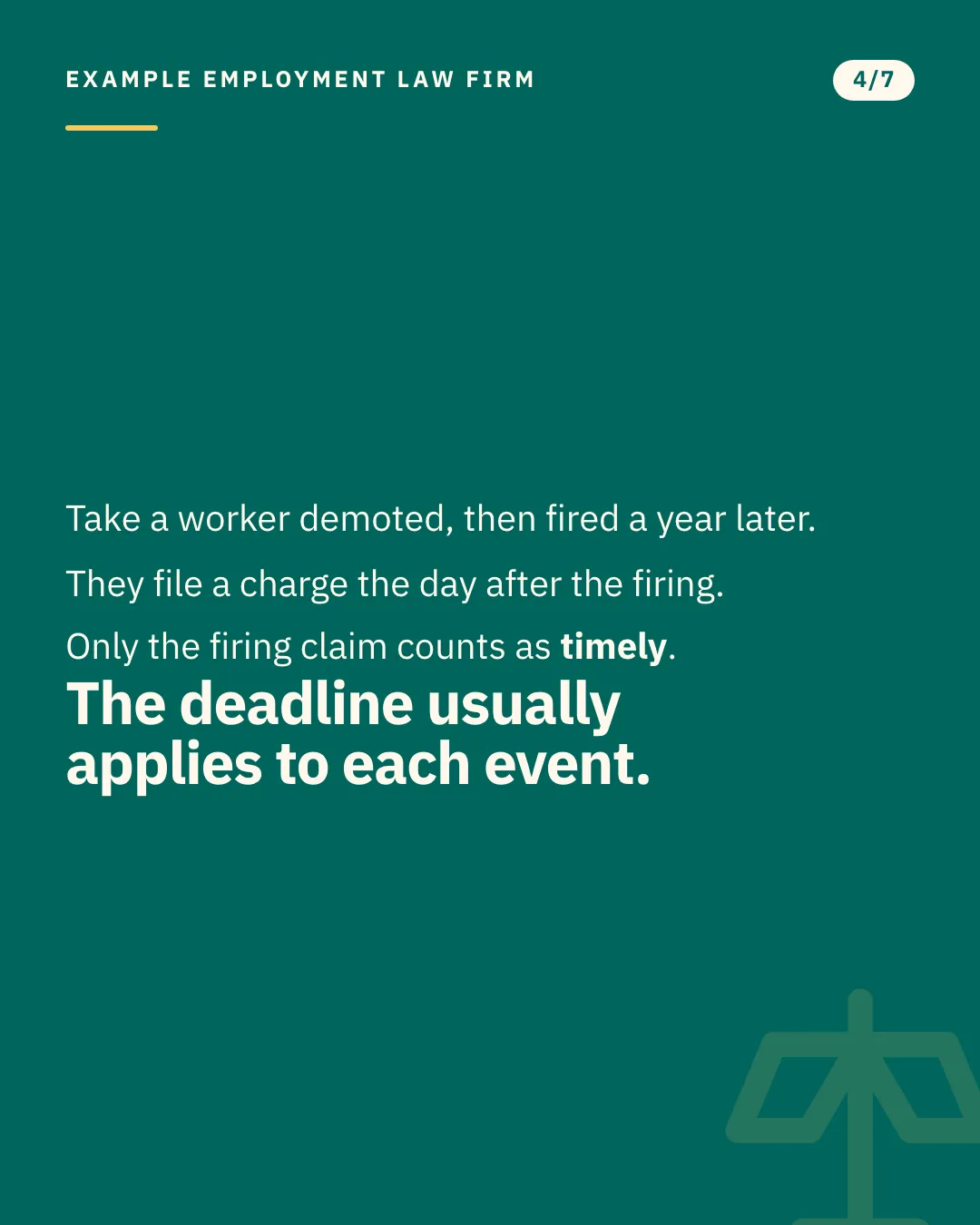
A discrimination charge generally has a 180 calendar day deadline, extended to 300 in some cases. Each event usually gets its own deadline.

Pay works on its own clock. Under the Equal Pay Act, the EEOC says the deadline is two years from the last discriminatory paycheck, or three years for willful discrimination.

It also says filing a Title VII charge will not extend the deadline for an Equal Pay Act lawsuit.

Save this for the next time someone at work says they will just wait and see.

#employmentlaw #workplacediscrimination #EEOC

  1. Example employment law firm · Sample1/2

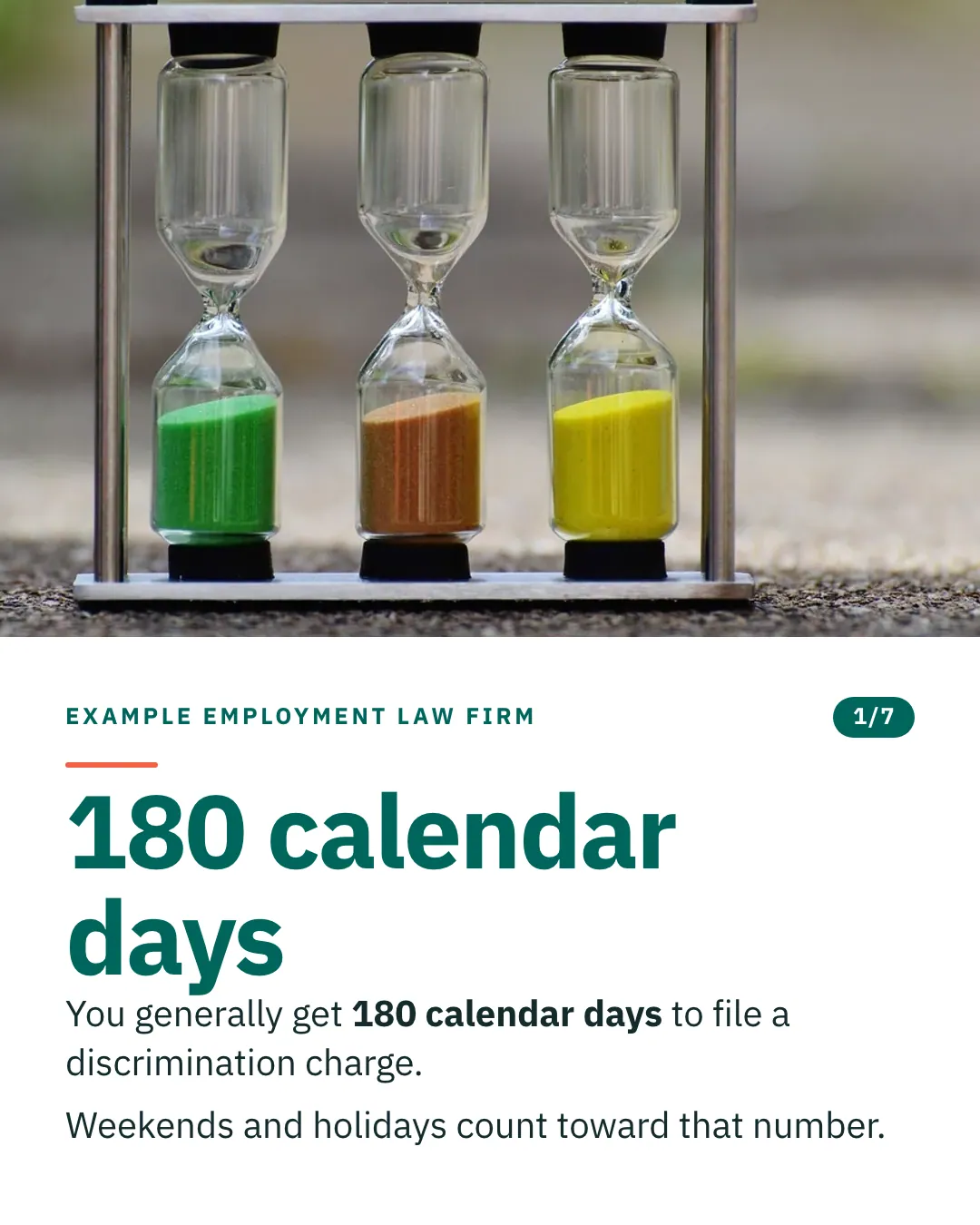
    The EEOC says you generally get 180 calendar days to file a discrimination charge. That can extend to 300 when a state or local agency enforces a law on the same basis. Weekends and holidays count.

    The discrimination filing clock
    ReplyRepostShare
Show this threadHide this thread
  1. Example employment law firm · Sample2/2

    Trying to resolve it through a union grievance, arbitration or mediation generally won't extend the EEOC time limit, the agency says. Those can run at the same time as a charge.

    ReplyRepostShare

Example employment law firm

Sample · not published
The general deadline to file a discrimination charge: 180 calendar days.

…see moresee less

Demoted, then fired a year later? In the EEOC's example, only the firing claim was on time.

A discrimination charge generally has a 180 calendar day deadline, extended to 300 in some cases. Each event usually gets its own deadline.

Pay works on its own clock. Under the Equal Pay Act, the EEOC says the deadline is two years from the last discriminatory paycheck, or three years for willful discrimination.

When a workplace issue first surfaces at your organization, who writes down the date?

The discrimination filing clock
CommentShare

Example employment law firm

Sample · not published
The general deadline to file a discrimination charge: 180 calendar days.

…see moresee less

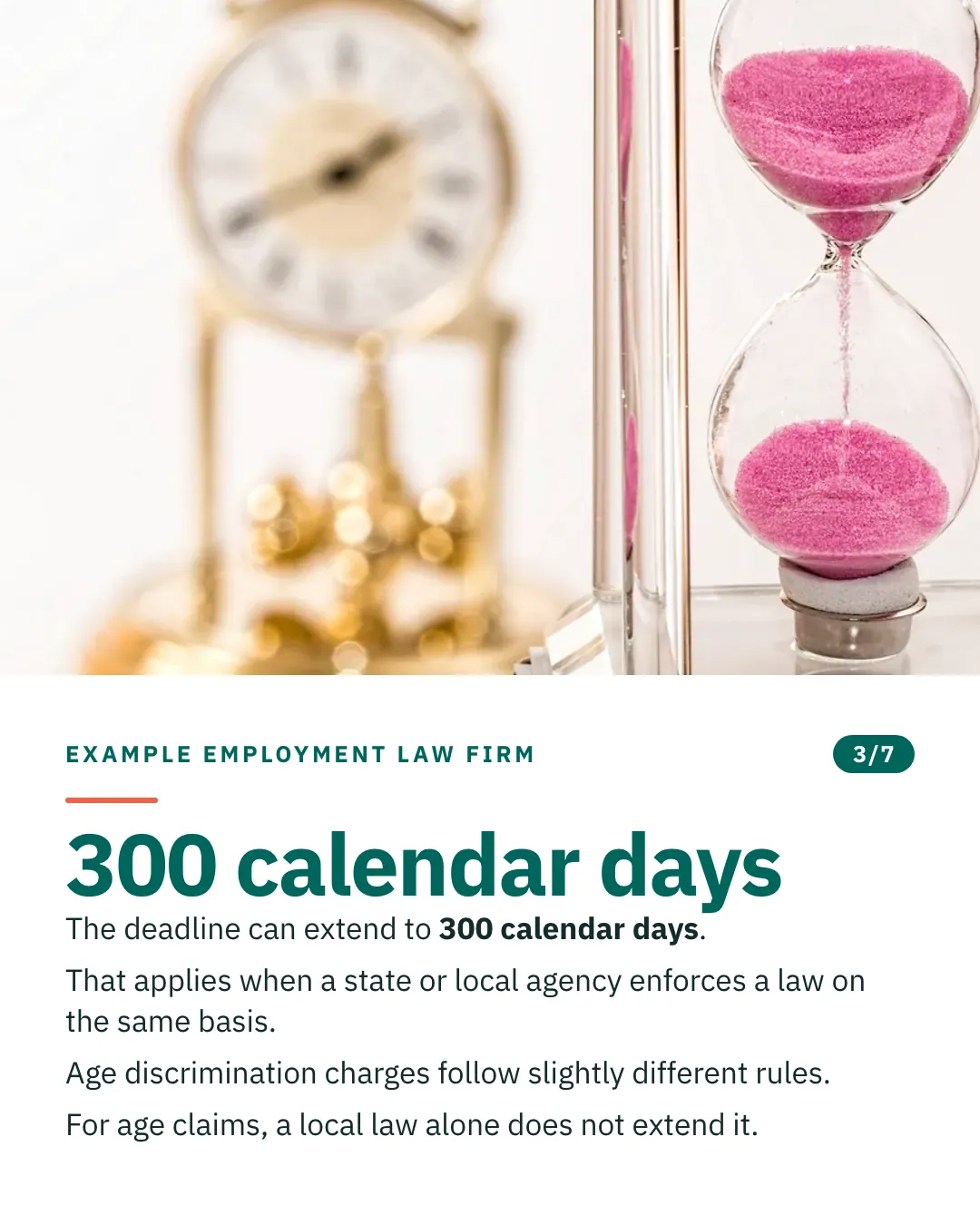
The EEOC says that window extends to 300 calendar days when a state or local agency enforces a law against employment discrimination on the same basis. Holidays and weekends are included in the count.

For anyone who runs a team, the timing detail matters. The EEOC says the deadline usually applies to each discriminatory event.

In its example, a worker is demoted and then fired a year later, and files the day after the firing. Only the discharge claim is timely.

The EEOC also says time limits generally will not be extended while a dispute goes through another forum, such as an internal grievance, a union grievance, arbitration or mediation. Those can be pursued at the same time as the charge.

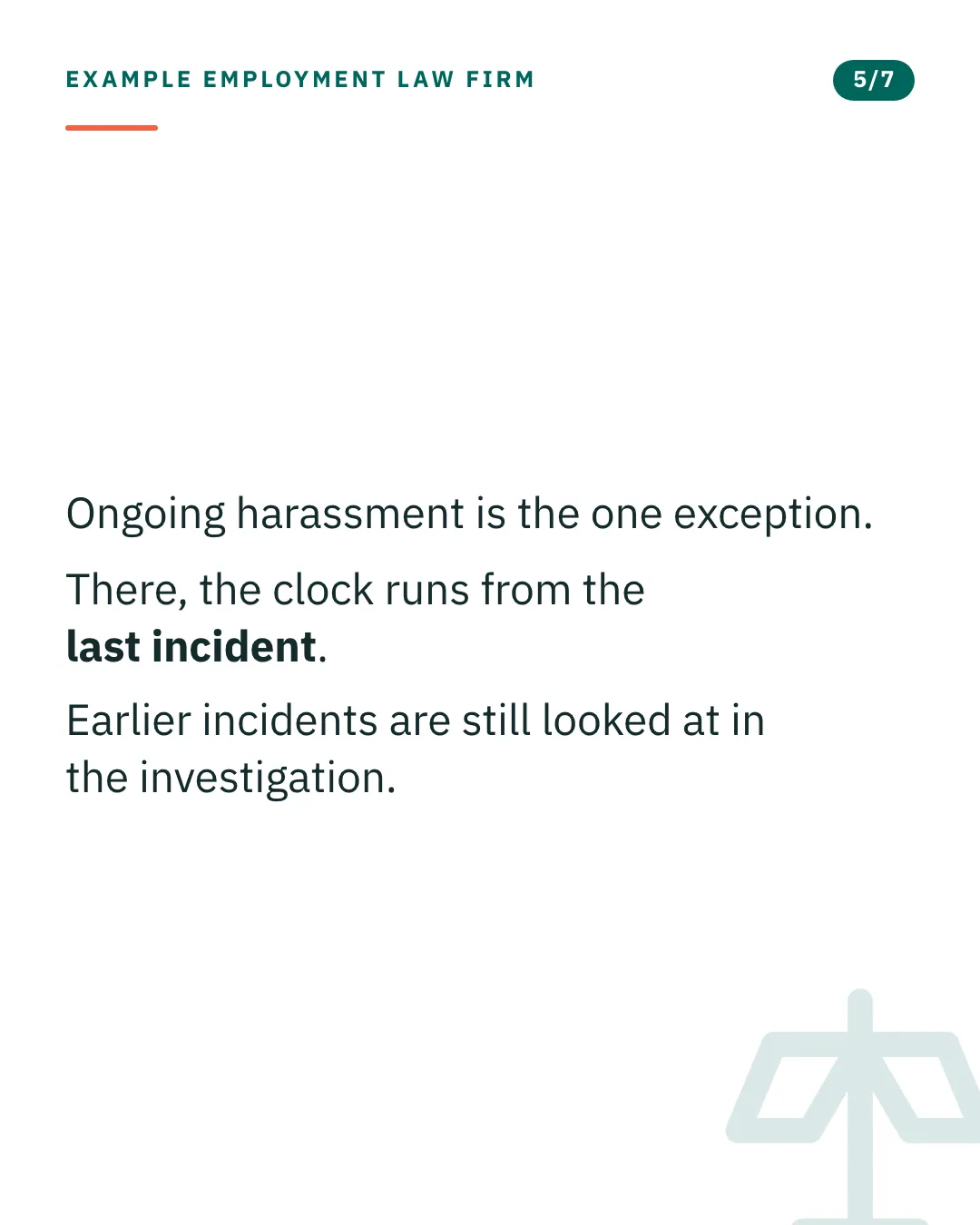
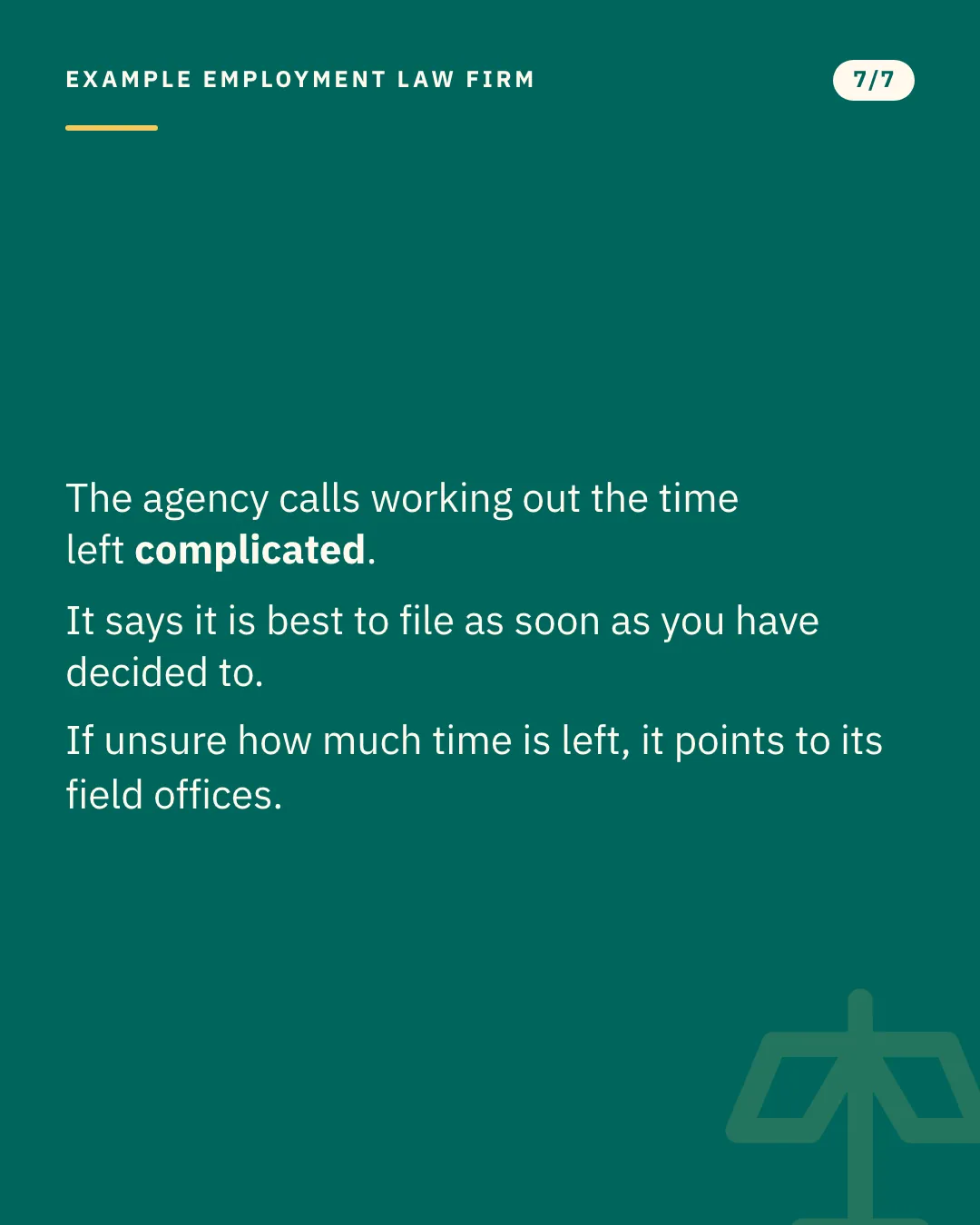
Ongoing harassment is the exception: there, the filing window runs from the last incident. The agency itself calls figuring out the time left complicated.

When a workplace issue first surfaces at your organization, who writes down the date?

The discrimination filing clock
CommentRepostSend

An example post for employment law practices. We write for any local business.

From your business to finished posts.

You receive finished work, not software to operate.

  1. We learn your business

    Who you serve, how you sound, what you cannot say.

  2. We find what is worth saying

    Questions your audience will recognise this week.

  3. We write and check it

    Words per channel, pictures beside them, claims verified.

  4. You approve and post

    Approve it, ask for a repair, or pick another.

What arrives, every week.

  • We read your own pages and write from them.
  • Finished posts for each channel, with their pictures.
  • Every claim quoted from a page you can open.
  • You approve. Nothing publishes on its own.

Questions

Do you publish for me?

No. We prepare the posts and you approve them. Nothing publishes automatically.

Do you understand employment law practices?

We learn your business from your own pages, and a post says about you only what they support. Its other facts come from public sources it names, which you can open.

What do I actually receive?

Finished posts for each channel, with their pictures, ready for you to approve and post.

What does it cost?

Three monthly plans, from $99 a month. See the plans

Choose how often you post.

A long post is one researched topic, finished for each channel your plan covers.

Every plan includes

  • Business-relevant topic research
  • Finished posts for each channel, with their pictures
  • Claim, quality, and fit checks
  • Ready for your approval

Presence

A concrete, low-friction start

$99per month

Up to 4 long posts a week

Up to 16 long posts a month

Prepared for 2 selected channels

Plus short posts on X, rolling out: up to 1 a day, 30 a month.

Join the waitlist for Presence

Authority

Higher-volume visibility

$249per month

Up to 2 long posts a day, 14 a week

Up to 60 long posts a month

Prepared for up to 4 selected channels

Plus short posts on X, rolling out: up to 4 a day, 120 a month.

Join the waitlist for Authority

Only delivered posts that pass our checks count against your allowance. Failed drafts and repairs never do.

Stop managing content. Start reviewing finished work.

We bring the words, the pictures and the checks. You approve, and you post.

Join the waitlist
Papergale

Finished content, researched and checked before it reaches you.

Privacy© 2026 Papergale